9 min read
What If Butterflies Are the World's Memory Banks?

A butterfly passed in front of her at the exact moment she understood something she had not been thinking about.
She had been walking without particular purpose along a gravel path between fields. The afternoon was ordinary. Her mind was not working on anything. And then, without announcement, an idea arrived. Not a memory exactly. More like a thought returned to her after a long absence — an idea that felt both unfamiliar and known.
She looked up. The butterfly had already passed. She did not make a connection between the two events. Why would she?
The experiment that refused to be forgotten
In 2008, a team of researchers at Georgetown University published a paper with a title that sounded like a riddle: Retention of Memory through Metamorphosis: Can a Moth Remember What It Learned As a Caterpillar?
In a laboratory, tobacco hornworm caterpillars — Manduca sexta, the larvae of a large, night-flying moth — were placed inside small chambers. A particular odour, ethyl acetate, was released into the air. For a caterpillar, ethyl acetate smells like nothing good. But in this experiment, the odour was followed by something worse: a mild electric shock.
The caterpillars learned fast. Within a few trials, they avoided the odour. They had formed an associative memory — the simplest and most ancient kind of learning: this smell means danger. In the wild, that kind of memory keeps an organism alive.
The trained caterpillars were then allowed to do what caterpillars do. They ate. They grew. They spun cocoons.
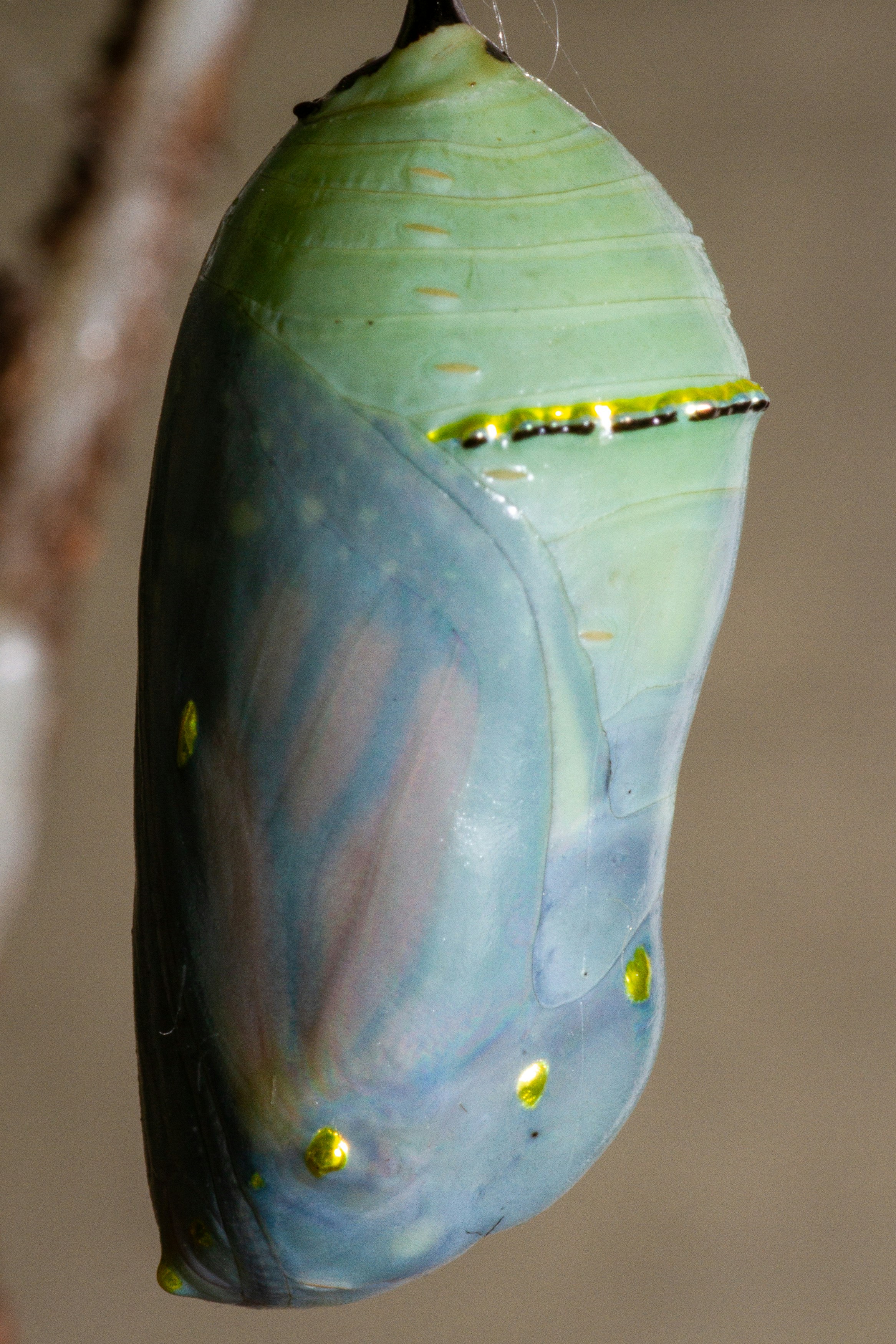
Inside those cocoons, something dramatic happened. The caterpillar body dissolved into a chemical soup. Imaginal discs — clusters of cells that had been dormant since the egg stage — activated and began constructing an entirely new body: wings, compound eyes, a proboscis, six long legs. The caterpillar that entered the cocoon no longer existed as a physical form.
When the adult moths emerged, the researchers tested them again. The same odour. No shock this time — just the smell. And the moths avoided it.
The same individual organism, across the boundary of complete physical dissolution, retained a learned association.

What the experiment does not prove
This is the point where the internet gets it wrong.
The Georgetown study did not demonstrate "genetic memory." It did not show that memories can be inherited by offspring. It did not prove that epigenetic marks transmit autobiographical experiences across generations. It did not even show that all memory survives metamorphosis — only that some forms of associative learning can persist within a single organism.
The caterpillar and the moth are the same individual. What survived was not a generational transfer. It was a continuity — a thread pulled through the eye of a needle that should not have had a hole.
Retained memory through metamorphosis is not the same as transmitted memory to descendants. The distinction matters. Science builds on precision. Wonder, when it is honest, builds on what science leaves open.
What survives transformation
The popular image of metamorphosis — caterpillar dissolves into goo, goo reorganises into butterfly — is not wrong, but it is incomplete. Some structures survive. Before dissolving, certain clusters of neurons in the larval brain reorganise rather than die. Research published in eLife in 2022 showed that in fruit flies, seven of ten computational compartments in the larval mushroom body — the insect brain structure responsible for learning and memory — are incorporated into the adult brain. Their input and output neurons remodel. They do not disappear.
The caterpillar does not fully forget itself. It reorganises.
This is the physiological fact that allows the Georgetown experiment to make sense. Some small but significant fraction of the nervous system persists through the meltdown. The organism that emerges from the chrysalis is not a clean-slate replacement. It is a continuation, rebuilt from pieces of the original.
<div class="pull-quote" aria-hidden="false"> <p>Memory may travel not as a message, but as a disturbance.</p> </div>
The chrysalis as archive
Science ends here. Imagination begins with what the evidence allows us to wonder.
If a moth can carry a learned odour aversion across the gulf of metamorphosis, what else might cross that boundary? Not complete scenes. Not narrative memory in any human sense. But fragments. Impulses. Attraction. Avoidance. Direction. Timing. Fear. Preference. Rhythm. Instinct. Unfinished emotional information.
Consider the chrysalis not as a grave but as an archive — a compression chamber where experience is not destroyed but re-encoded into a smaller, stranger format. The caterpillar's life reduces to a signal. The moth carries that signal forward into a body that has never known the caterpillar's world but moves through it as though it remembers.
The wings as memory surfaces
Look closely at a butterfly wing. At the microscopic scale, the coloured scales overlap like tiles on a roof — thousands of them per square millimetre, each one a precise structure of chitin and pigment. The patterns they form are not random. They are maps.
A map of what? In evolutionary terms: of predators avoided, of flowers preferred, of seasons survived, of migrations completed, of ancestors who lived long enough to reproduce. The wings carry the accumulated decisions of every generation that preceded this one.
They are not memories in any literal sense. But they are records. Visible traces of invisible history.

The wingbeat theory
Speculation begins here. What follows is literary and philosophical imagination. It is not a scientific claim.
A butterfly wing moves through air at approximately ten to twelve beats per second. Each beat displaces a small volume of atmosphere — about a teaspoon of air — and sends a pressure wave outward at the speed of sound. The wave is too small for human ears to register. It cannot carry words or images or structured thought.
But a disturbance does not need to carry a message to carry an effect.
The wingbeat moves more than air. It moves dust particles. Pollen grains. Scent molecules released by nearby flowers. Water vapour. The vibrations travel through leaves and grass, through spiderwebs and the surfaces of puddles, through the sensory hairs of other insects. None of this is mysterious. It is physics.
What if memory travels the same way? Not as a complete thought delivered intact across distance. But as a disturbance — a small rearrangement of what was already present. A scent fragment triggers an association. A vibration shifts attention. A pattern of light reflected from a wing catches the corner of an eye and redirects a train of thought. The butterfly does not send a memory. It releases a disturbance that becomes a memory in the receiver.

How an idea might arrive
You are walking. You are not trying to solve anything. And then — an image appears in your mind without an identifiable source. A fear without a remembered event. Nostalgia for a place you have never visited. A sentence that feels discovered rather than written. Recognition without explanation. A solution that arrives before conscious reasoning catches up.
Psychology offers explanations. Implicit memory: knowledge acquired without conscious awareness, stored in neural pathways that fire before the prefrontal cortex can narrate what is happening. Subconscious association: the brain connecting sensory input to stored experience faster than language can keep up. Pattern recognition: the mind detecting relationships that deliberate thought would take hours to reconstruct. Cultural inheritance: ideas transmitted through language, gesture, architecture, and ritual over centuries. Environmental cues: the angle of light, the temperature of air, the particular green of a leaf triggering a cascade of associations laid down years earlier.
All of these are real. All can explain the sudden arrival of an idea without needing a butterfly.
But the butterfly was there. The wing moved. The air shifted. A scent reached you that you did not consciously notice. A pattern of light flickered at the edge of your peripheral vision. Your brain did what brains do: it wove the disturbance into the fabric of your ongoing thought, and the result felt like an idea arriving from nowhere.
The butterfly did not deliver a message. But it changed the conditions in which your thoughts were occurring. And that change produced something new.

The world's memory banks
Nature stores information everywhere.
DNA is a memory system — a four-billion-year archive of what worked and what survived. Nervous systems store experience in synaptic weights. Migration routes — the paths that monarch butterflies follow from Canada to Mexico, the routes that birds trace across continents — persist across generations without any single individual knowing the full path. Seeds store instructions for entire organisms in packages smaller than a grain of rice. Tree rings encode climate history. Coral skeletons record ocean chemistry. Soil holds the chemical traces of every plant and animal that has lived and died in a given place. Rivers carry sediment from mountains to sea, distributing minerals that become new organisms. Animal behaviour transmits information: a chimpanzee teaching its young to use a tool, a whale song changing across seasons.
And then there is human language — the most recent and most volatile of the world's memory systems. Words carry experience across time and space with a fidelity that biology cannot match. But they also degrade, distort, and forget.
The butterfly, in this framework, is not unique. It is simply the most visible embodiment of a principle that operates everywhere: transformation does not require erasure. Change and continuity are not opposites. They are partners in the same slow process of carrying information forward.
Return
The woman on the gravel path did not prove anything. She did not try to. She noticed a thought that had not been there a moment before. She noticed a butterfly that was no longer there. She did not connect the two.
She kept walking. The idea stayed with her. She did not know where it had come from, and after a while she stopped trying to know.
The butterfly landed on a thistle fifty metres behind her, folded its wings, and rested. In a few hours it would lift off again. The air would move. Light would scatter. A scent would drift. A disturbance would propagate outward in all directions, too small to measure but present. And somewhere, in someone else, another thought would arrive without explanation.
References
-
Blackiston, D. J., Silva Casey, E., & Weiss, M. R. (2008). Retention of memory through metamorphosis: Can a moth remember what it learned as a caterpillar? PLOS ONE, 3(3), e1736. https://doi.org/10.1371/journal.pone.0001736
-
Georgetown University. (2008, March 5). Can moths or butterflies remember what they learned as caterpillars? EurekAlert! https://www.eurekalert.org/news-releases/642170
-
Truman, J. W., & Riddiford, L. M. (2022). Metamorphosis of memory circuits in Drosophila reveals a strategy for evolving a larval brain. eLife, 11, e80594. https://doi.org/10.7554/eLife.80594
-
Gammon, K. (2023, July 26). Insect brains melt and rewire during metamorphosis. Quanta Magazine. https://www.quantamagazine.org/insect-brains-melt-and-rewire-during-metamorphosis-20230726
-
Weiss, M. R. (2016). Defensive responses of larval Manduca sexta and their sensitization by noxious stimuli. Journal of Experimental Biology, 219(15), 2345–2355.
-
Scott, K. (2008). Taste recognition: Food for thought. Neuron, 57(1), 4–6.
Imagery by Unsplash contributors. This essay is a work of speculative nonfiction: the science cited is real and verifiable; the philosophical extensions are imaginative, not empirical. The central distinction is preserved throughout: associative memory can survive metamorphosis within a single organism. The idea that butterflies distribute the world's memories through their wings is a literary invention. It is offered as an invitation to wonder, not as a claim to truth.